
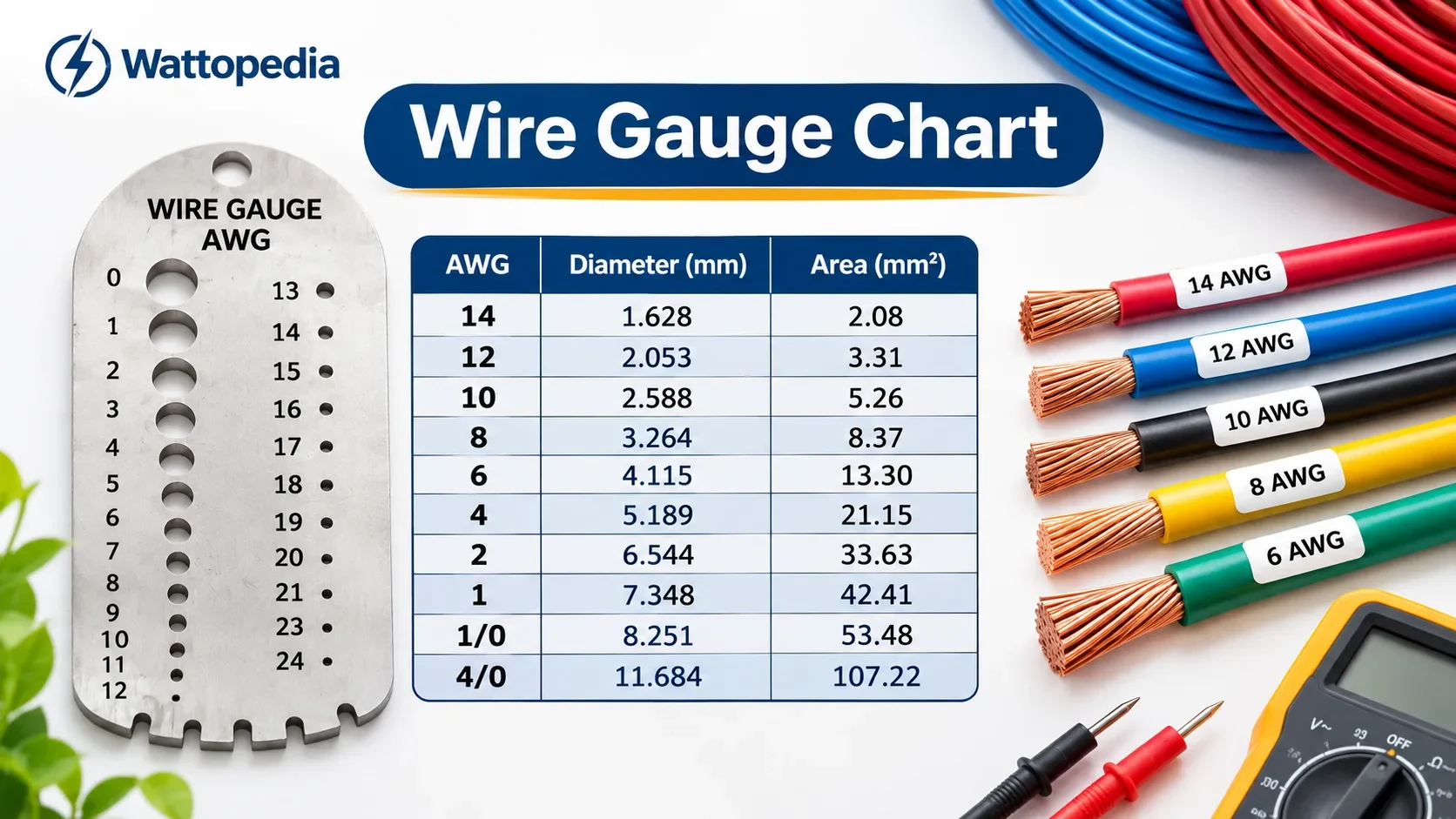
A wire gauge chart can show nominal diameter, cross-sectional area or resistance. Read each column's units and material conditions first. A dimension chart does not by itself say how much current a finished wire or cable can carry.
Use the reference table for the actual lookup
The AWG copper diameter and resistance chart is Wattopedia's reference table. Use it for the listed nominal sizes and source conditions. This guide explains how to interpret that table; it does not duplicate the rows or add a breaker-selection table.
Diameter and area answer different questions
Diameter is a length across a circular conductor. Cross-sectional area measures the size of the circular section. A diameter expressed in millimeters is not an area expressed in square millimeters.
Worked geometry example: a hypothetical circular conductor with a 2 mm diameter has a 1 mm radius. Its area is π × 1², or approximately 3.1416 mm². These are example dimensions, not an AWG product specification or an electrical current rating.
For an AWG size, the AWG-to-area calculator follows its documented nominal geometry. For a real product, retain the manufacturer's construction and dimensional information.
Read the resistance conditions with the number
Resistance is stated for a particular material, temperature and length. Keep all of those conditions when copying a table value. Comparing values per foot and per meter requires a length conversion; comparing resistance at different temperatures requires an appropriate material model.
A return path matters in a circuit calculation. The copper DC voltage-drop worksheet explains its two-wire path and fixed model assumptions. Its result does not establish an installation-safe wire size or confirm code compliance.
Why this guide omits an ampacity column
Nominal geometry is not a universal allowable-current table. Product construction and installation requirements need separate review. Wattopedia does not currently provide the code-table ampacity checks previously described in this post; those claims and unsupported selection examples have been removed.
Is mm² the same as wire diameter?
No. mm² is an area unit. A diameter requires a length unit such as mm. Check the column heading before using or copying the value.
Does a thicker conductor automatically approve an installation?
No. A size comparison cannot approve a circuit or determine a protective device. Have the actual equipment and installation requirements reviewed by a qualified professional.
Which page should I use next?
Use the reference chart for table rows, the calculator for area conversion, or the cable-label guide to understand an AWG marking. Each page serves a different task.
Sources and method
NBS Handbook 100, Copper Wire Tables, section 2 and its nominal wire-geometry tables. Accessed 15 November 2026. Numerical conversions on Wattopedia are reproducible with the AWG-to-area calculator. This article does not reproduce ampacity tables.