
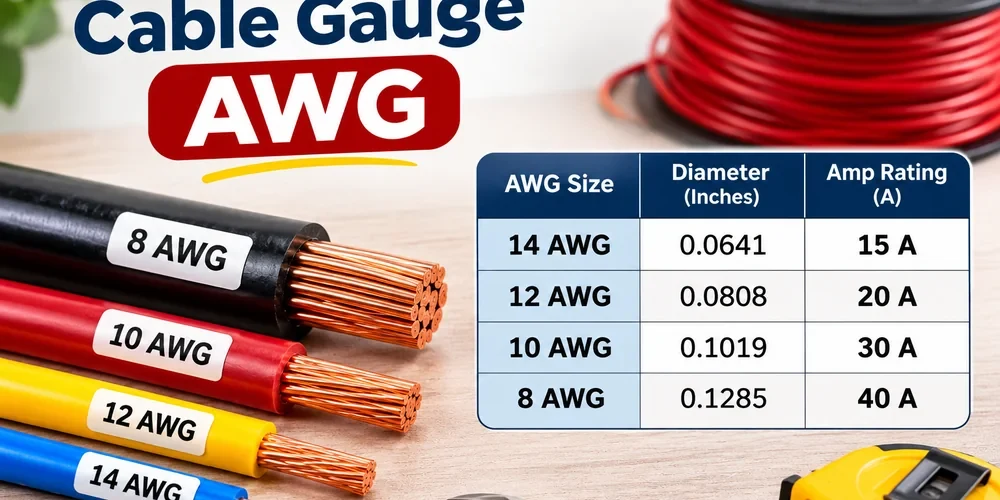
Cable gauge AWG describes a conductor's nominal size. Within the AWG scale, a smaller gauge number means a larger conductor. The label alone does not establish the cable's outside diameter, allowed current, breaker rating or suitability for an installation.
Read the conductor size separately from the cable description
Start by identifying which marking describes the conductor gauge. Then read the manufacturer's separate markings for conductor material, construction and insulation. Do not treat an AWG size as a complete cable specification.
AWG is a geometric scale. The wire-size reference chart provides nominal diameter and resistance context; its columns are different measurements. The AWG definition explains the term without implying a current rating.
Why a lower AWG number is larger
The AWG diameter relationship decreases as the gauge index increases. You can compare sizes using the published equation rather than judging thickness from the number alone. Insulation and a cable jacket add dimensions that this nominal conductor calculation does not describe.
Check area when comparing a metric specification
A diameter in millimeters and an area in square millimeters cannot be compared as if they were the same quantity. Use the AWG-to-mm² calculator to reproduce the nominal geometric conversion. For a stranded or finished product, check the manufacturer's actual construction and dimensions.
Worked comparison: select 12 AWG, then 14 AWG in the calculator and compare their area results. The smaller AWG index produces the larger nominal area. This comparison says nothing about which conductor is permitted for a particular circuit.
Keep resistance and current rating separate
A resistance reference needs its material, length and temperature conditions. A voltage-drop calculation also needs the circuit model and the complete current path. Neither a resistance value nor an area conversion establishes ampacity. Wattopedia's copper voltage-drop worksheet is a limited physical model, not a code-table equipment selector.
Does AWG include insulation thickness?
No. The nominal geometry used here describes the conductor. Use the product dimensions to check the outside size of an insulated wire or cable.
Can an AWG label tell me which breaker to use?
No. Do not infer a breaker or fuse rating from this article or its dimension links. Use the actual product documentation and a qualified electrical review of the installation requirements.
Where should I look up a size instead of a definition?
Use the wire-size chart for reference rows and the area calculator for a selected nominal size. This article is a guide to reading the labels, not another ampacity chart.
Sources and method
NBS Handbook 100, Copper Wire Tables, section 2 and its nominal wire-geometry tables. Accessed 15 November 2026. Numerical conversions on Wattopedia are reproducible with the AWG-to-area calculator. This article does not reproduce ampacity tables.