
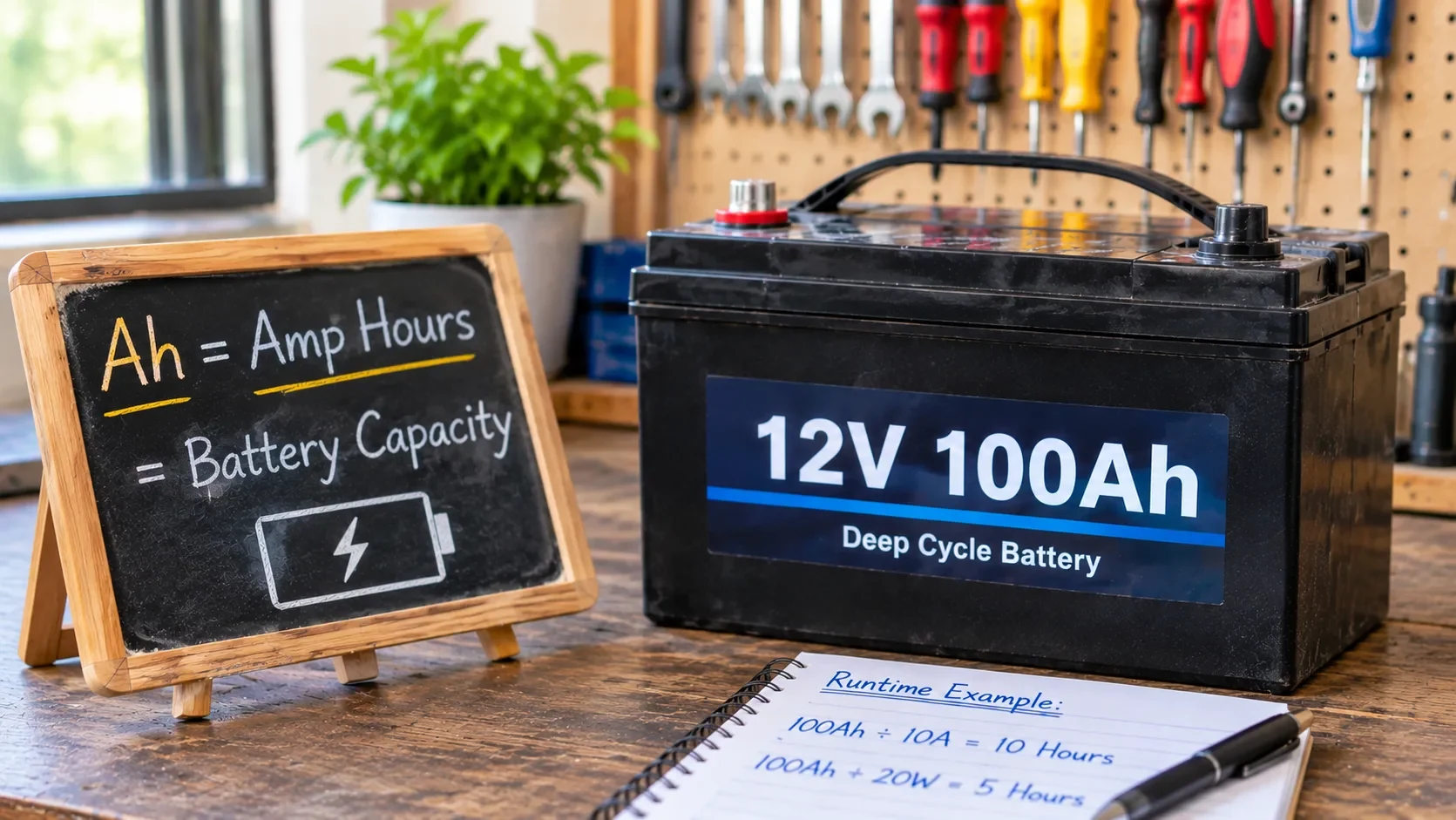
So, what does Ah mean on a battery? Ah stands for amp hour, and it measures battery capacity, which is how much charge the battery can hold. A 100Ah battery can ideally supply 100 amps for one hour, or 10 amps for 10 hours.
Picture the battery as a bucket. Ah is the bucket’s size. It doesn’t tell you how fast you pour or how strong the flow is. Once you see that, every label makes sense, from a 5Ah power bank to a 200Ah deep cycle battery.
What does Ah mean on a battery label?
A label like “12.8V 100Ah 1,280Wh” holds three clues. The first number is nominal voltage. The second is capacity in Ah. The third is stored energy. If Wh isn’t printed, multiply Ah by volts to get it.
Phones use mAh, a smaller unit. One Ah equals 1,000mAh. A 5,000mAh phone battery is 5Ah, or about 18.5Wh at 3.7V.
What does Ah mean on a 12V battery?
The “12V” is a nominal figure. The real voltage rises and falls as the battery charges and drains. Battery voltage and capacity only make sense together. A 12V 100Ah and a 24V 100Ah both say “100Ah,” but the 24V one holds twice the energy.
Two mental shortcuts help on a 12V battery:
Ah × 12 gives roughly Wh.
Watts ÷ 12 gives roughly amps.
Here’s how amp hours vs watt hours play out. Convert with Wh = Ah × volts.
Battery | Volts | Ah | Wh |
12V lead acid | 12V | 100Ah | 1,200Wh |
12V lithium battery (LiFePO4) | 12.8V | 100Ah | 1,280Wh |
12V 200Ah battery | 12V | 200Ah | 2,400Wh |
24V battery | 24V | 100Ah | 2,400Wh |
For the deeper version, read the battery capacity vs power guide.
What does Ah mean on a battery in real use?
There are three numbers: rated Ah on the label, usable Ah you can safely draw, and delivered Ah you actually get after cold, age and heavy loads. Only the last two decide your runtime.
Lead acid batteries are often kept near 50% usable to protect their life. Many lithium makers allow much more, so check the datasheet. A deep cycle battery is built for repeated deep draining. A starter battery is built for short, strong bursts.
Size also varies. Paleblue Earth (2025) lists car batteries at roughly 40 to 100Ah, and deep cycle batteries from 50Ah to over 200Ah.
How long does a 100Ah battery last?
It depends on your load and usable capacity. Divide usable watt hours by the load in watts. A 12V 100Ah lithium battery with about 1,150 usable watt hours runs a 100 watt load for roughly 11 hours. A lead acid battery of the same size gives about half that.
These are example assumptions at a steady 100W DC load, not guarantees.
Battery | Nominal Wh | Assumed usable | Hours at 100W |
100Ah lead acid | 1,200 | 50% (600Wh) | 6 |
100Ah lithium | 1,280 | 90% (1,152Wh) | about 11.5 |
200Ah lithium | 2,560 | 90% (2,304Wh) | about 23 |
Want to see why real battery life comes out shorter? The battery run time formula guide explains it, and the battery runtime calculator does the math for you.
How many amp hours do I need?
Add up your daily watt hours. Divide by battery voltage, then by the usable fraction, and add about 20% margin. That gives the Ah you need. For 280Wh a day on a 12V lithium battery with 90% usable, you need about 31Ah.
Here’s where 280Wh comes from. Say you run LED lights (20W for 5 hours), a laptop (50W for 3 hours) and two phones (about 30Wh). That’s 100 + 150 + 30 = 280Wh. A 100Ah lithium battery would cover about four days, ignoring losses.
Any amp hour calculator or battery capacity calculator follows these same steps. Try the battery size calculator, or the solar battery size calculator if panels will recharge it.
Does a higher Ah mean more power, and is a 200Ah battery better?
A higher Ah means more stored charge and usually longer runtime, not more power. At the same voltage, a 200Ah battery runs a load twice as long as a 100Ah one. It’s also heavier and costs more. Power depends on voltage and the maximum discharge current.
Need current from watts? Use the watts to amps calculator. Two 12V 100Ah batteries in parallel make 12V 200Ah. In series, they make 24V 100Ah. The series vs parallel batteries guide shows both.
How long does battery charging time take?
Battery charging time is roughly Ah divided by charger amps. A flat 100Ah battery on a 20 amp charger needs about 5 hours in ideal conditions. Real charging takes longer because of losses and a slower final stage, especially with lead acid.
Other battery calculators on Wattopedia cover charge time and capacity.
Which Ah myths should you ignore?
Myth | Fact |
Higher Ah means a stronger battery. | It means more stored charge. Strength depends on volts and discharge limit. |
Compare batteries by Ah alone. | Compare Wh, because voltage changes the energy. |
A 100Ah battery always gives 100Ah. | Cold, age and heavy loads cut delivered capacity. |
AC runtime equals DC runtime. | Inverters waste some energy. Plan for it with the inverter size calculator. |
Ah equals cranking amps. | Cranking amps measure a short starting burst. Ah measures endurance. |
Every runtime here is an estimate. For safety decisions, use the maker’s data.
Conclusion
Now you know what Ah means on a battery: the size of the bucket. Pair it with voltage to get watt hours, then divide by your load to estimate runtime. Next step: write down your devices’ watts, pick your voltage, and run your numbers through the tools above before you buy.
FAQs
Can I use a higher Ah battery in my device?
Usually yes, if the voltage matches and the device and charger support it. A higher Ah battery just runs longer.
Why doesn’t my battery deliver its full rated Ah?
Cold temperatures, age, heavy loads and deep discharging all reduce usable capacity below the label.
Is a lithium battery’s full Ah usable?
Often more of it is usable than with lead acid, but the amount varies by maker. Check the datasheet.
Does a car battery use Ah too?
Yes, but car batteries are usually judged by cranking amps for starting. Ah matters more for deep cycle use.
What can I find on Wattopedia?
Wattopedia offers free electrical calculators, guides and reference charts. Each tool shows its formula, inputs and assumptions, and there’s no account needed.