
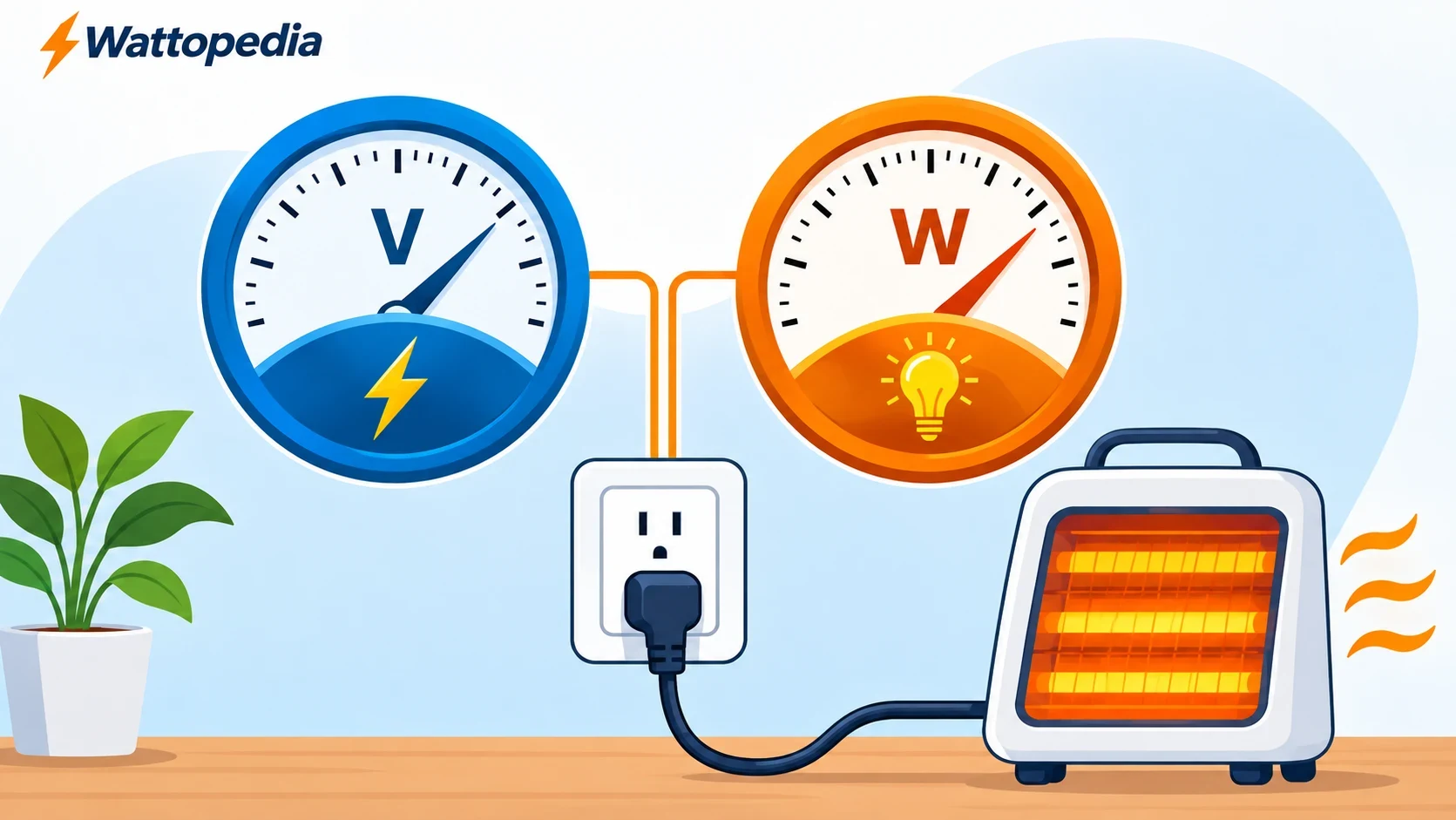
Volts measure electrical pressure. Watts measure how much power a device actually uses or delivers. That’s the difference between watts and volts in one line, and it holds until you add the third number on every appliance label: amps. Watts are what you get when volts and amps work together, so you can’t turn volts into watts without knowing the current.
A US wall outlet sits at about 120 volts whether a phone charger or a space heater is plugged into it. The volts stay the same. The watts change enormously, because each device pulls a different amount of current.
Volts are the push, watts are the work
Think of a garden hose. Voltage is the water pressure in the line. Current (amps) is how much water flows.
Power (watts) is the work that water can do, like spinning a sprinkler. High pressure with a pinched nozzle does very little. Low pressure with a wide open pipe can still move a lot of water.
The formal versions are less poetic. A volt is the unit of electrical potential difference between two points in a circuit. A watt is the SI unit of power, equal to one joule of energy per second. The two are tied together by a single relationship:
Watts = Volts × Amps
One watt is the power you get when one amp flows across a difference of one volt. The unit is named after the Scottish engineer James Watt, and according to the Wikipedia entry on the watt, it became part of the SI in 1960.
So volts can exist on their own. A battery sitting in a drawer has voltage and delivers zero watts, because nothing is drawing current. Watts only show up when something is actually running.
Why the same watts can mean very different amps
This is the part that matters when you buy, plug in or wire anything.
Take a 1,500 watt space heater. On a 120 volt US outlet it draws 12.5 amps (1,500 ÷ 120). Run the same 1,500 watts on a 240 volt circuit and the current drops to 6.25 amps. Same heat in the room, half the current in the wire.
Now flip to low voltage. A 120 watt device on a 12 volt car system pulls 10 amps. Plug that same 120 watt load into a 120 volt outlet and it needs just 1 amp. That’s why car and RV wiring uses thick cables for loads that would barely register in a house: at 12 volts, every watt costs ten times the current it would at 120.
Current is what heats wires and trips breakers. Watts tell you the job, volts tell you the system, and amps tell you whether the wire and breaker can handle it.
If you want to run the numbers for your own devices, the watts to amps calculator does the division for DC, single phase and three phase circuits, and the amps to watts calculator works it the other way.
Here’s a quick comparison using round numbers:
Load | At 12 V | At 120 V | At 240 V |
|---|---|---|---|
60 W | 5 A | 0.5 A | 0.25 A |
120 W | 10 A | 1 A | 0.5 A |
1,500 W | 125 A | 12.5 A | 6.25 A |
That bottom left cell is why nobody sells a 12 volt space heater that actually heats a room.
Which number should you check on a label?
It depends on what you’re trying to find out.
Volts: will it work here?
A device built for 120 volts needs a 120 volt supply. Plug a 120 volt only appliance into a 230 volt socket abroad without a converter and you’ll likely damage it (many phone and laptop chargers list 100 to 240 V on the label and handle both). Before you travel, look up your destination on Wattopedia’s voltage by country list. For batteries, USB ports and other gear, the device voltage reference gives sourced figures (USB is 5 V nominal, a car battery is a 12 V system).
Watts: what will it cost and what can power it?
Watts decide how much a device costs to run, how big a generator or inverter you need, and how long a battery will last.
Amps: is the circuit safe?
The current tells you if a circuit, extension cord or breaker is up to the job. The breaker size calculator and the wire size calculator are good starting points, though an electrician should sign off on any permanent wiring.
Your electric bill counts watts, never volts
Utilities don’t charge for voltage. They charge for energy, which is watts multiplied by time, billed in kilowatt hours (kWh). One kWh is 1,000 watts running for one hour.
The US Energy Information Administration reports that the average residential electricity price was 16.5 cents per kWh in 2024, and the average home used 865 kWh a month. That national average hides big swings by state, so the rate on your own bill is the number to use.
Using that 2024 average, the 1,500 watt heater running four hours a day uses 6 kWh, or about $0.99 a day. Over a 30 day month that’s roughly $30 for one heater. Plug your own wattage, hours and rate into the electricity cost calculator to see your real figure. If you don’t know a device’s wattage, the appliance wattage calculator can estimate it.
That’s the practical difference between watts and volts on a bill: voltage played no role in that math. A 1,500 watt heater costs the same to run on 120 volts or 240 volts.
Watts vs volts: “How many watts are in a volt?”
There’s no fixed answer, and any chart claiming one is wrong. A volt and a watt measure different things, the way miles per hour and miles do. You need the current to connect them.
If you know two of the three values, you can always find the third:
Watts = Volts × Amps
Volts = Watts ÷ Amps
Amps = Watts ÷ Volts
The watts to volts calculator and volts to watts calculator handle this, including the power factor that AC motors and some electronics add. If resistance is the value you know, the Ohm’s law calculator solves for whatever is missing.
Quick answers
Is higher voltage more dangerous than higher wattage?
Voltage drives current through your body, so it governs shock risk. Wattage tells you how much power a device uses. Both deserve respect, and household 120 volt circuits can kill.
Does a higher wattage bulb use more electricity?
Yes. A 60 watt bulb uses 60 watt hours for every hour it’s on, no matter the voltage. LEDs give the same light at far fewer watts.
What size inverter do I need for a 12 volt battery?
Add up the watts of everything you’ll run at once, then add headroom. The inverter size calculator walks through it, and the battery runtime calculator shows how long the battery will last.
Start with the label in your hand
Find the volts first to confirm the device matches your outlet, then the watts to estimate what it costs to run. Those two numbers answer most real questions, and the amps tell you whether your circuit can keep up.