
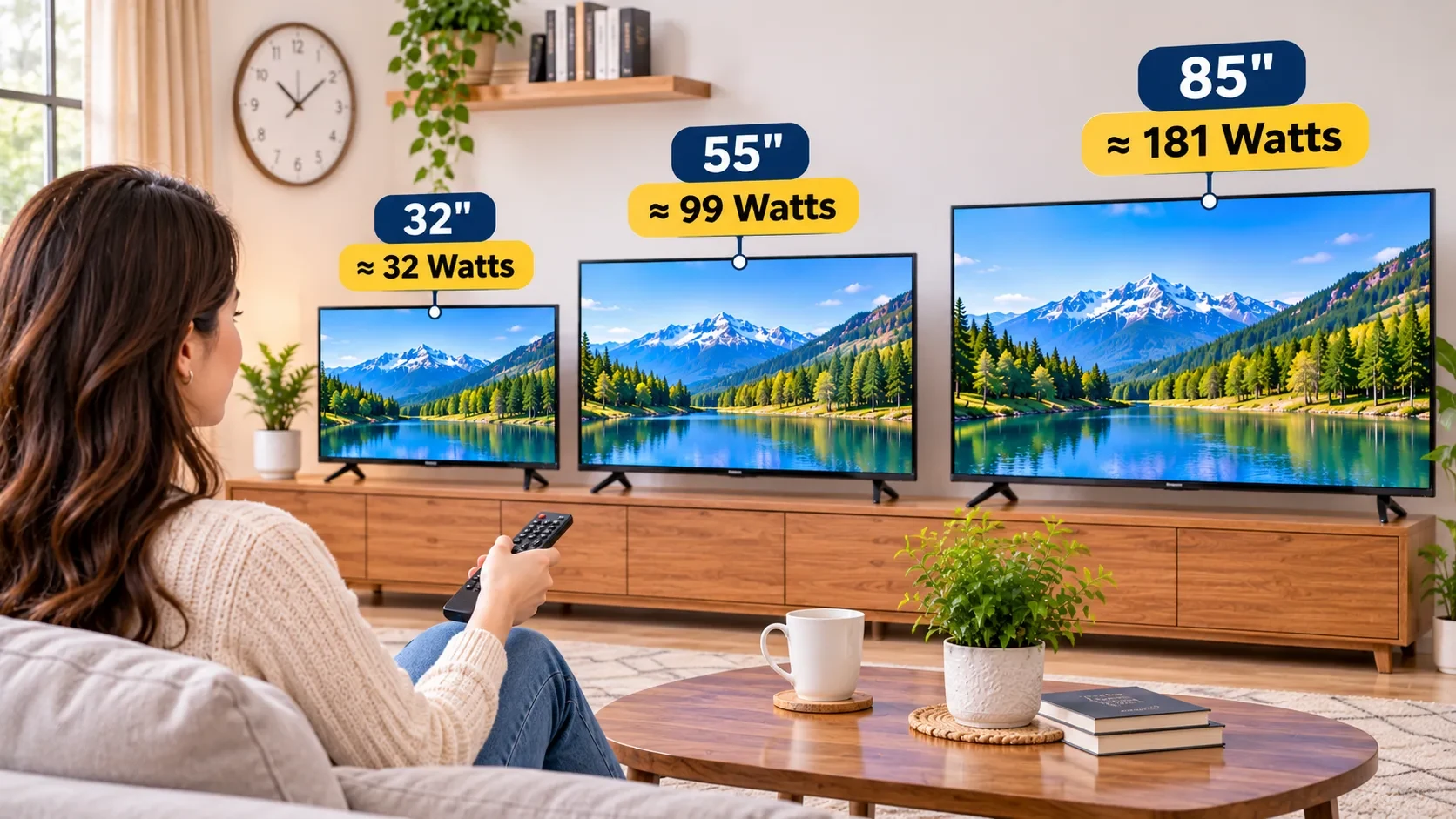
How many watts does a TV use? A new 55 inch TV uses about 99 watts while it’s on, a 32 inch set uses about 32 watts, and an 85 inch set uses about 181 watts. At the US average price, that 55 inch screen costs about 1.8 cents an hour to run, which is cheaper than most people guess.
These numbers come from median test results for ENERGY STAR certified TVs (ENERGY STAR dataset, retrieved October 2026, analyzed by Green Calculus), so they show what new, efficient sets draw. Older TVs often use more. Below, you’ll find watts by size and panel type, a simple cost formula, and one hidden setting that can make the hours your TV is “off” use more power than the hours you watch. Want to check another gadget first? Try the appliance wattage calculator.
How many watts does a TV use by screen size?
Screen size is the biggest factor in average TV power consumption. A new 32 inch TV uses about 32 watts, a 55 inch TV about 99 watts, and an 85 inch TV about 181 watts. Each size step adds roughly 11 to 33 watts.
Screen size | Watts on | Cost per hour | kWh per year | Cost per year |
32 inch | 32 W | 0.6 cents | 33 | $6.01 |
43 inch | 63 W | 1.1 cents | 63 | $11.46 |
50 inch | 74 W | 1.3 cents | 73 | $13.31 |
55 inch | 99 W | 1.8 cents | 97 | $17.59 |
65 inch | 119 W | 2.2 cents | 116 | $21.06 |
75 inch | 148 W | 2.7 cents | 144 | $26.19 |
85 inch | 181 W | 3.3 cents | 175 | $31.83 |
Yearly figures assume 2.6 hours a day (BLS, 2025), 0.4 W standby and 18.19 cents per kWh (EIA, 2026). Even the 85 inch giant costs less per year than many streaming subscriptions cost per month.
How much does it cost to run a TV?
A 55 inch TV costs about 1.8 cents an hour, $1.47 a month and $18 a year at the US average of 18.19 cents per kWh. The formula is watts × hours ÷ 1,000 × your price per kWh.
Here’s what that looks like in real life for a 55 inch set:
What you do | Hours | Energy | Cost |
Watch a movie | 2 | 0.2 kWh | 3.6 cents |
A normal evening | 4 | 0.4 kWh | 7.2 cents |
A weekend binge | 6 | 0.59 kWh | 10.8 cents |
Leave it on all day | 24 | 2.37 kWh | about 43 cents |
Think of watts as speed and kilowatt hours (kWh) as distance. So how much electricity does a TV use over time? Watts times hours, divided by 1,000. For TV power consumption per hour, divide the watts by 1,000. The electrical glossary explains more terms.
Your rate matters more than the TV. The same 55 inch set costs about $12 a year in North Dakota and $45 in Hawaii. At the 2.6 hour US average, TV electricity usage per month is about 8 kWh. For the electricity cost of running a TV at your rate, use the electricity cost calculator as a TV electricity cost calculator.
How much electricity does a 55 inch or 65 inch TV use?
A 55 inch TV uses about 99 watts. How many kWh does a TV use then? About 0.099 kWh per hour. A 65 inch TV uses about 119 watts, or 0.119 kWh per hour. Panel type shifts the numbers a little.
Panel type | 55 inch | 65 inch |
LED or QLED | 85 W | 114 W |
OLED | 103 W | 127 W |
OLED TV power consumption runs higher than LED TV power consumption at both sizes. At 2.6 hours a day, the gap costs $2 to $3 a year. That’s too small to decide on a purchase.
What about 4K and smart TVs? Our data groups are set by size and panel type, not resolution, so we can’t give a clean 4K TV power consumption figure. Smart TV electricity consumption shows up mostly in standby, and that’s where the plot twist lives.
How many watts does a TV use in standby?
A new certified TV uses about 0.4 watts in standby, roughly 57 cents a year. ENERGY STAR caps TV standby power consumption at 0.5 watts, or 1 watt for network connected TVs (criteria effective 2022). Homes can differ a lot.
Here’s the twist. NRDC’s 2015 study of Northern California homes found idle TVs averaging 13 watts. Some sets with quick start used up to 37 watts around the clock. Quick start keeps the TV half awake so it turns on faster.
At 13 watts, a 55 inch TV’s off hours use about 102 kWh a year. That’s more than the 94 kWh it uses while you watch. This is TV energy consumption you never see.
Why does the Energy Guide label show a higher cost?
The label assumes 5 hours on and 19 hours in standby every day, at 16 cents per kWh (FTC labeling rule, amended 2024). That’s more viewing than the 2.6 hour US average. For a 55 inch TV it shows about 183 kWh and $29 a year. Use it to compare TVs, not to predict your bill.
How many watts does a TV use in your home?
How much power does a television use in your home? Check the label on the back, or use a plug in watt meter. The label shows a maximum rating. A meter shows what your TV actually draws.
Try this 60 second check:
Find the amps and volts on the label. Say it reads 0.7 A at 120 V. Use amps to watts: 0.7 × 120 = 84 W.
Have watts and need current? Try watts to amps.
Voltage varies by country, so see voltage by country.
With a meter, note watts while watching, watts when off with the remote, and kWh over one week.
Myth or fact: what should you believe?
Myth: big TVs are power hogs. Fact: an 85 inch set is about $32 a year at the US average rate.
Myth: off means zero. Fact: standby draws power, and quick start can draw much more.
Myth: the label shows my bill. Fact: it shows a comparison, not your viewing habits.
Easy ways to save:
Turn quick start off. NRDC advises this if it uses more than a couple of watts.
Put the TV, soundbar and console on one switched power strip. Leave your router on.
Pick a size that fits your room, since each step up adds watts.
Look for the ENERGY STAR label.
How long can a battery run a TV?
A 99 watt TV runs about 8.6 hours on a 1,000 Wh battery. The math is 1,000 × 0.85 ÷ 99, with 15 percent lost in the inverter. Try the battery runtime calculator, and check the inverter size calculator for matching gear.
What do these numbers miss?
ENERGY STAR certifies only efficient models, so these numbers are the low end of what sits in homes. Television energy usage on older sets is higher, and we haven’t metered any TV ourselves. Read our methodology to see how we handle sources.
What should you do next?
So, how many watts does a TV use? Most new TVs use about 32 to 181 watts while on, and under 1 watt in standby when set up well. Size sets the number, and quick start can quietly double the cost. Next step: measure your TV, switch off quick start, then compare other devices in the appliance wattage chart.
FAQs
How many amps does a TV use?
Amps equal watts divided by volts. A 99 watt TV draws about 0.83 amps at 120 volts and about 0.43 amps at 230 volts.
Do older TVs use more power?
Often yes. Honda Power Equipment budgets 190 watts for a 46 inch flat screen as a cautious planning figure. Planning a generator? Use the generator size calculator.
Do a soundbar or game console add to TV power use?
Yes. Each adds its own standby draw. A switched power strip can cut them together. Keep your router and any recorder plugged in so they can update.
Is it cheaper to unplug a TV than to use standby?
For a new certified TV, standby costs about 57 cents a year, so unplugging saves little. The bigger win is turning off quick start or using a switched strip for the whole setup.
What is Wattopedia?
Wattopedia offers electrical calculators, reference tables and guides. Each tool shows its formula, inputs and assumptions, and you don’t need an account.